Ascension and Spiritual Stations (maqam’at) in the Legend of Zelda: The Ocarina of Time
The Legend of Zelda: The Ocarina of Time is a deeply evocative journey upon the initiate path to a realm beyond forms and into the heart of wisdom. The adventures of the childhood Link–his upbringing-in-exile in the mysterious and bucolic Kokiri Forest, entry upon the vast plains of Hyrule and encounter with the princess, the climb to the peaks of the perilous Mount Death and subsequent immersion into the literal belly of the whale in Zora’s Realm–represent spiritual stations (in Sufi terminology, maqam’at) upon the quest for enlightenment. In a world imperiled by the rapacious greed and egotism of the evil Ganondorf, Link must secure the Triforce–the combined essences of power, wisdom, and courage–representing the unity of divine attributes (tawhid al-sifat) needed to restore balance to the realm of Hyrule.
Link’s inopportune withdrawal of the Master Sword as a child causes a rift in time, as the young hero is frozen for a subsequent seven years until he is of an age capable of taking on his destiny. In the meantime, Ganondorf’s evil has been released, afflicting Hyrule with evil curses. Awakening unto an afflicted and cursed land, Link must undergo trials by making his way through various temples (maqam’at–spiritual stations), each one marking a step upon the path of reaching the most exalted station–al insan al-kamil (the perfected man). By entering into the dark and unknown future and thereupon bringing together the dispersed pieces of the Triforce, Link enters into a state of descent and self-annihilation(fana’) followed by ascent and subsistence in God(baqa) as the completed Triforce brings order and unity (tawhid) to Hyrule, uniting it with the sacred realm (analogous to the Kingdom of God on Earth).
The Realm of Hyrule itself represents what, in the language of Ibn Arabi, is called al ‘alam al-mithal (the imaginal world). This realm represents a half-way point between the physical world (al ‘alam al-ajsam) and the realm of spirits (al ‘alam al-arwah). Made up of dark forests, vast deserts, rolling plains, harsh mountains, and deep canyons and lakes, Hyrule represents various forms of liminality, that is, a borderland between worlds (what is called barzakh, an “intermediate zone” between physicality and the spirit world).
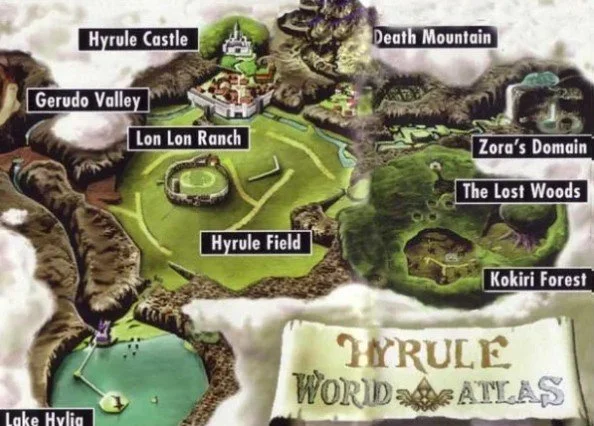
Map of Hyrule. Although Link begins ensconced within the relative safety of Kokiri Forest, he sets out upon the vast Hyrule Field, which serves as a gateway to liminal realms (mountains, rivers, lakes, deserts).
Link begins his journey as a child orphan (al-yatim, in Quranic Arabic) within the Kokiri forest, a realm that represents a form of hijab (literally, “veiling,” or “shrouding”) from the inner truth (al-haqq). Regardless, Link also maintains a boy-like purity (his inner fitrah, or a “primordial orientation towards this inner reality of God”). While Link’s forest home provides safety and structure–outer guardrails that match al-zahir (the visible, apparent realm of rules and prohibitions, corresponding to the shari’a, or “religious law.”)--the voice of Zelda gently calls him to his true destiny and a discovery of al-batin (a hidden, inner reality beyond forms corresponding to al-haqq). As an orphan from beyond the forest, Link is haunted by these calls to leave Kokiri Forest, whose child denizens (like the Lost Boys from Peter Pan) are unable to leave without perishing (or, growing old in the case of those leaving Never-Never Land).
Link is summoned to the Great Deku Tree, who informs him of his spiritual mission, he faces down the arrogant and self-appointed Mido (guardian of the forest–reprsenting self-doubt and cynicism). Link’s hesitations and obstacles in leaving the forest represent the initial refusal of the call, in the mythic language of Joseph Campbell, and which corresponds with similar myths (the Land of the Lotus Eaters, Circe, Calypso in Homer’s The Odyssey) where the hero must gather inner strength and courage to resist comfort and unconsciousness. Finally, it is the gentle yet melancholic farewell of his childhood friend Saria, whose precious gift of Saria’s Song provides Link with a melodic grounding with his origins (a form of dhikr, or remembrance) that sees him off into the world beyond Kokiri Forest. This song will serve Link well during moments of ghaflah, or headlessness, (moments of forgetting one’s divine origins) and will consistently call him back to the state of childlike innocence (fitrah).
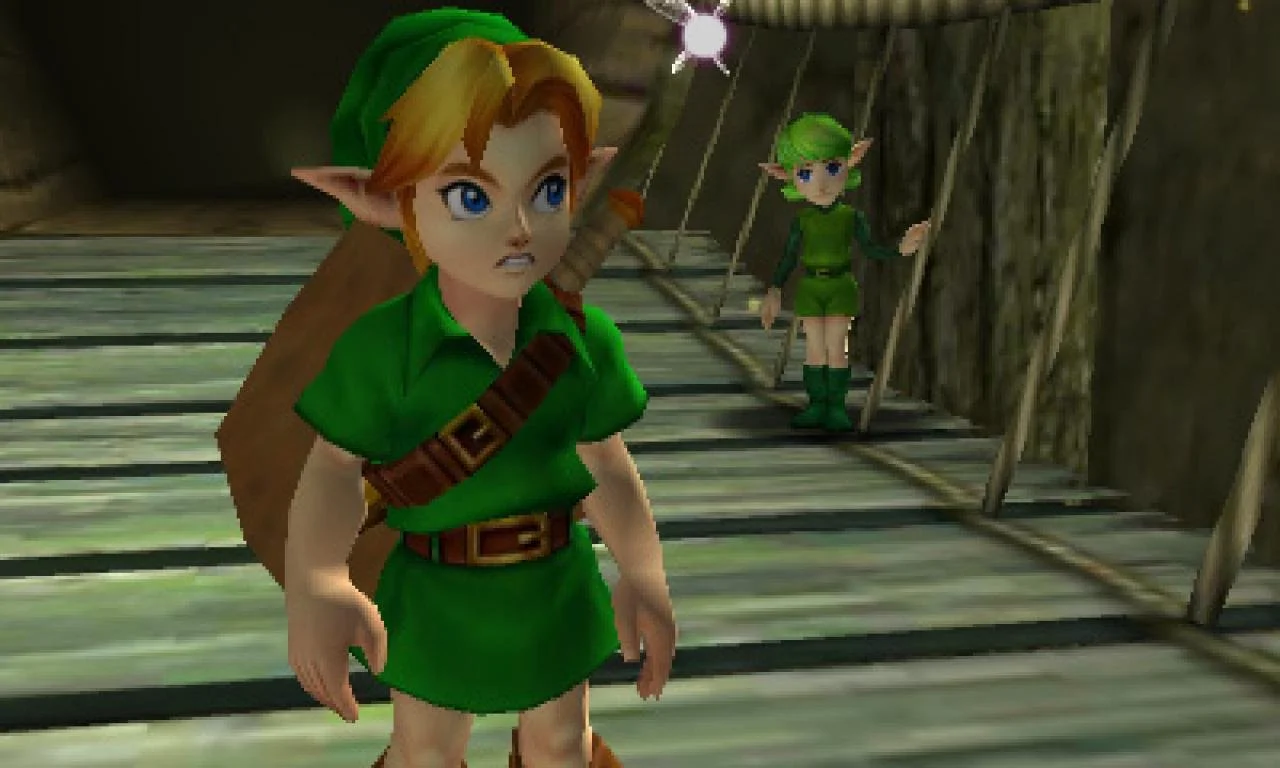
Link departs from Kokiri Forest after bidding farewell to his childhood friend, Saria. She leaves him with a song, a form of ‘dhikr’, or “remembrance,” of his inner goodness (fitrah) and divine origin.
Link’s emergence upon the vast expanses of Hyrule mark what Campbell has called the crossing of the first threshold. Link quickly enlists the aid of spiritual mentors, most notably his fairy companion Navi as well as the wise owl Kaepora Gaebora, who guide him along his journey. The journey of Moses or Christ into the desert as well as the departure of Gilgamesh beyond the walls of Uruk correspond to this initial threshold. Meanwhile, kindly guides such as Gandalf, Merlin, Obi-Wan Kenobi, or Athena in the case of Odysseus emerge to guide the hero upon his or her path.
Hyrule Field itself represents the wide-open realm of possibility. In contrast to the narrow trails of Kokiri Forest, it feels vast despite its own enclosed nature. Hyrule Field is a land in-between, and can be seen to represent al-tariq (literally, “the way”), that takes one from the outer zahir of reality (al-qishr, or “shell”) to the inner batin (al-lubb, or “kernel”). During the day it is sunny, welcoming, and hospitable. A land of trees, milk, and plenty. During the night, skeletons and ghosts (poes) emerge. These night creatures are mostly harmless and easily defeated, yet rise seemingly out of nowhere. As light recedes and nightfall settles, these apparitions can be interpreted as half-formed impulses, whispers of the ego (literally, waswisu, or “whispers” in Quranic Arabic).
In the middle of the field stands Lon Lon Ranch, where Link befriends Malon, who cares for the horses in the wake of her father Talon’s lazy absence. It is through initiation and courage as an adult when racing the arrogant Ingo, the false usurper of the ranch, that Link wins Epona, his loyal steed. While Talon’s kind-hearted but incompetent lack of vigilance allows the ranch to fall into disorder, Ingo’s cold, calculated seizure of authority leads to a lack of heart and love, and Epona eventually chooses the harmony and competence represented by Link as he has matured and undergone initiation. In Sufi terms, Talon can be seen as lacking muraqabah, or "vigilance," while Ingo is clearly roiling within zulm, “oppression” born by the wounded ego. Epona is not neutral property and her purified soul (al nafs al-hayawani, or “animal soul”) chooses right order and love over incompetence or cruelty. The liberating jump over the ranch fence (which subsequently crashes) as Link escapes with Epona is truly a moment of infiraj, or “relief after spiritual distress.” As a place of rest, Lon Lon Ranch represents a place of sukun (“silence”) for the young adventurer, a safe haven.
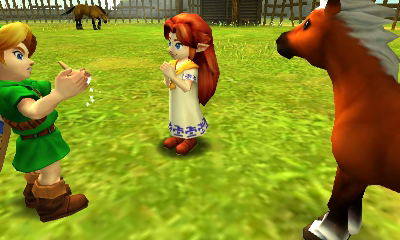
Link, Malon, and Epona at Lon Lon Ranch. Link wins the heart of Epona through ‘muraqabah,’ or “spiritual vigilance” after proving himself capable of right action in the face of incompetence and cruelty.
The initial boyhood encounter with Zelda within the gardens of Hyrule Palace represents an encounter with vertical authority and Link’s alignment with duty, purpose, and wisdom (hikmah). The courtyard garden itself is a liminal space, or “barzakh” between worlds. Zelda herself represents an encounter with sophia (the muse of wisdom) and the divine feminine. In Jungian terms, Zelda represents the anima, the inward, mystical, feminine part of the soul that Link must fully integrate to mature. Zelda, much like the Oracle of Delphi (or the Oracle in the Matrix for that matter), introduces prophecy, instruction, and destiny. Link’s sly and mischievous act of sneaking into the garden itself represents a movement beyond the zahir, or “outer” shape of appearances into the realm of the ‘ilm al-batin (‘ilm al-ladunni),, or “inner, inspired knowledge beyond forms. The dark shadow cast by Ganondorf’s sudden appearance in the castle window sets a contrast between the integrity of sacred knowledge represented by Zelda with the nafs al-mutakebirrah, or “arrogant soul,” as represented by the villain, who bows in mock submission to the king yet remains dominated by ego. Much like Iblis (Satan) or the Pharaoh of Egypt, Ganondorf views himself as self-sufficient, seeking to grasp power without the necessary act of humility and self-emptying (kenosis) of the ego. Ultimately, it will be the boyish Link that will need to embark upon the required descent into the underworld (‘fana, or “self-annihilation”) in order to emerge fully human and to apprehend the greater presence of God (tajalli, “self-disclosure” of the divine) .
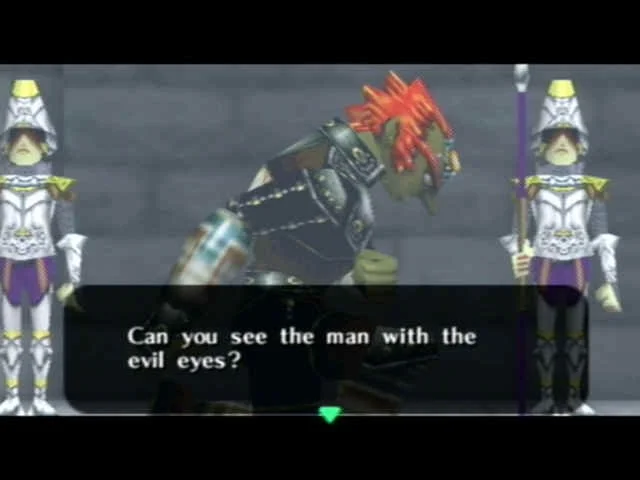
At Hyrule Castle, we get our first glimpse of Ganondorf, who represents the ‘nafs al-mutakabirah,’ or “arrogant, self-aggrandizing soul.” Link will need to see past Ganon’s perfidy, lies, and delusion in order to defeat him.
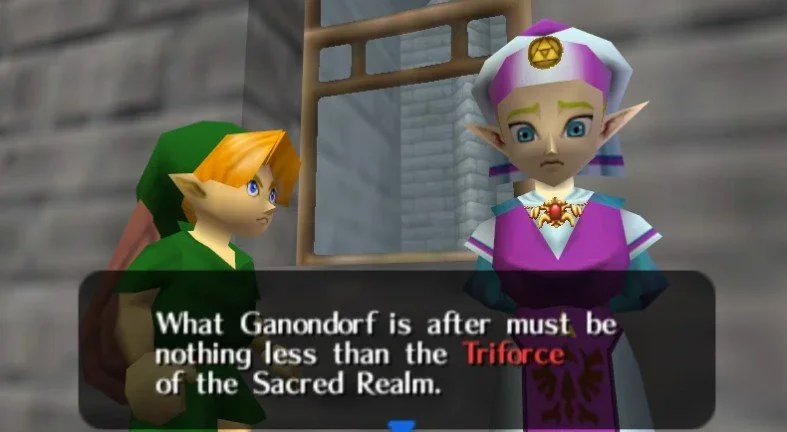
Link’s boyhood meeting with Zelda puts him on the path of destiny, as he is summoned to bring back unity to the Triforce (the combined virtues of power, wisdom and courage)
Link sets off from the castle to capture the two remaining sacred stones required to open the Temple of Time and release the Master Sword. While the Kokiri Emerald (recovered from the Deku Tree) represents childlike openness and receptivity, Link’s journey up into the fiery caverns of Mount Death and latter descent into the belly of the whale in Zora’s Realm represent the tariq (path) into the self-annihilation (fana’) of the ego, culminating in the capture of the Master Sword, the blade that separates truth from falsehood, and represents spiritual discernment.
Link journeys to the realm of the Gorons, a mountain-dwelling race of rock-eating humanoid giants, to find them starving. The entry to the sacred mines of the Gorons has been sealed by Ganondorf and infested with fire-breathing lizards and dragons, representing the burning of fear, anger, grief, and the downward pull of the ego. As a mujahid, or “sacred warrior,” Link marches through the purifying fire of the cavern and slays the Dodongo dragon, thereby restoring peace and recovering the Goron’s Ruby, the sacred stone of fire.
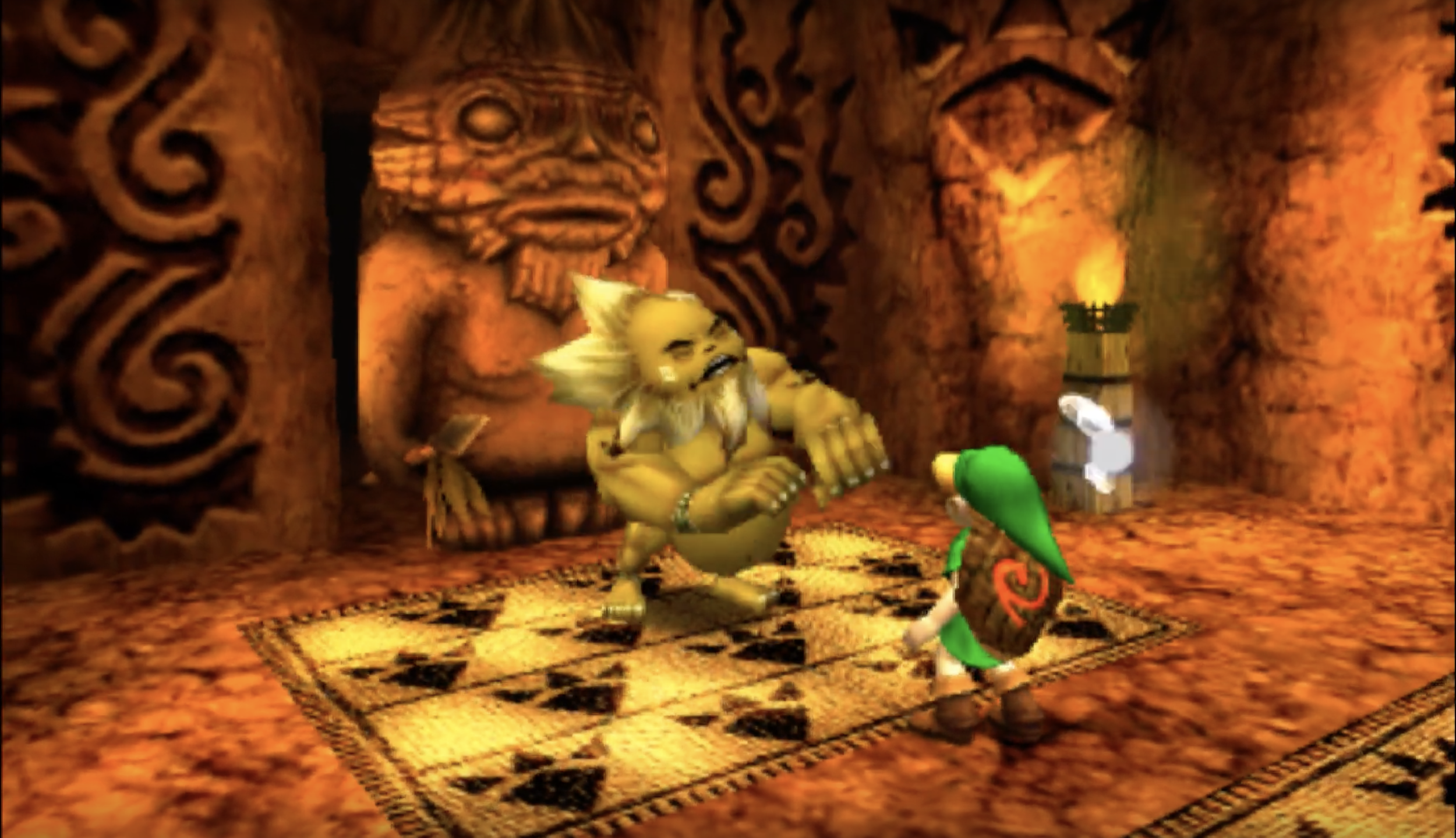
Link wins the trust of Darunia (King of the Gorons), whose mountain homeland has been choked out and infested with fire-breathing dragons (a reflection of the burning ego)
❝If the fire of wrath is not purified, it consumes the soul. But if tamed, it becomes the engine of sainthood.❞
— Sufi aphorism
Link then wanders into Zora’s Realm, where the young princess Ruto and her sacred sapphire hav been swallowed by the whale Lord Jabu-Jabu. Zora’s Realm, a land of deep canyons and rivers, represents flow and mercy as well as the unconscious. In the absence of the princess, waterfalls have frozen over, symbolic of a deep, spiritual blockage. Like the story of Jonah or Pinocchio inside Monstro, Link enters into the literal belly of the whale, a descent symbolizing the “womb of the world” and fana’ (annihilation) of the ego. The jaunty, flirtatious encounter between young Link and the princess–who jests about marrying him and offers Zora’s Sapphire as an engagement gift–helps us transition towards the end of Link’s boyhood adventures and return to Hyrule to claim the Master Sword.
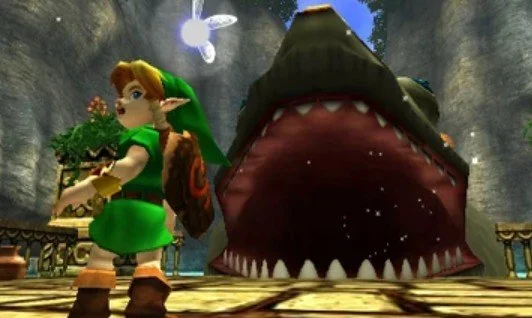
Link stands before Lord Jabu Jabu moments before being swallowed into the literal belly of the whale.
The Master Sword, one of the most evocative symbols of the Zelda universe, is a symbol of Link’s transition from boyhood to manhood and reflects a primordial claim to spiritual nobility. Having emerged from the twisted brambles of Kokiri Forest, the burning fires of Mount Death and frozen waters of Zora’s Realm, the hero Link now enters fully into the realm of adulthood, replete with the challenge and responsibility of protecting the sacred Triforce. However, while the Master Sword does confer upon the hero the ability to discern and cut away falsehood from truth, it also represents a metaphysical threshold between two realms. As Link withdraws the Master Sword, the seal which protected the sacred Triforce is broken, and Ganondorf is able to infiltrate the breach thereby corrupting Hyrule and claiming power over it. Thus, the sword represents both a right of passage in the Arthurian sense, and also initiates the hero upon a journey of descent (fana’) and later rise (baqa-subsistence in God) as a fully integrated human being (the insan al-kamil).
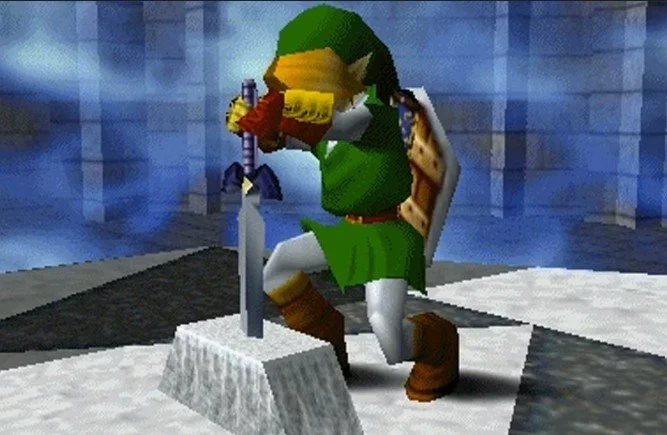
Link withdraws the Master Sword, which represents both a rite of passage into manhood as well as serves as metaphysical threshold (barzakh) between realms.
As Link withdraws the Master Sword, the young boy is frozen in a seven-year slumber (a sort of chrysalis, analogous to a cocoon from which the butterfly emerges). Having taken the Master Sword before he was fully ready, Link must now engage on a quest to recover five sacred medallions that offer access to the sages of the sacred realm. The medallions themselves are scattered among temples, which represent maqam’at, or spiritual stations, that Link must unlock before having the force to take on Ganondorf and restore the Triforce. The Forest Temple, for example, can be seen as representing childhood illusions that are swept away as Link clears out the darkness from it. The return to his childhood forest is symbolic and represents a form of tawba, or “repentance,” as Link truly ascertains the seriousness of his destiny and the trails on the road ahead. The Fire Temple represents mujahada, or “struggle,” while the labyrinths and puzzles of the Water Temple buried deep within Lake Hylia represent sabr, or “patience.” The boss battle with Dark Link (the Jungian shadow) is particularly evocative and symbolic, as the hero must wrestle with his own demons and weaknesses. The dark, lurking terrors of the Shadow Temple buried deep within the Kakariko Village cemetery and a relic of Hyrule’s murderous and violent past represents a true descent (fana’) into the unconscious. Finally, the Spirit Temple–obscured amidst the blowing sands of the Gerudo Desert–represents Link’s full integration of boy and man, since this temple requires the use of both the child and adult Link to complete. Most evocatively, the Spirit Temple guardians–twin witches representing fire and ice–need to be dispelled through the use of the mirror shield, which echoes the Sufi concept of the heart as a mirror that requires polishing to discern and illuminate the false dualities and illusions of earthly existence.
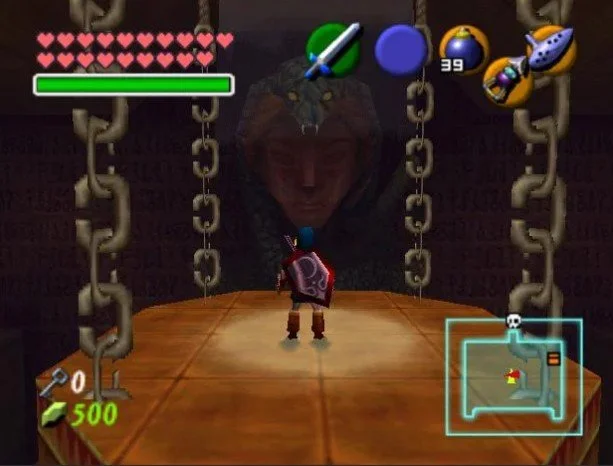
Link descends into the Spirit Temple while equipped with the Mirror Shield. The Sufi concept of the heart as a mirror in need of polishing (tazkiyat an-nafs, or “the purification of the soul”) is evoked, also through the use of symbolism (the presence of the Islamic ‘hilal,’ or “crescent” symbol on the shield).
As Link sets off for the temples–each representing a spiritual maqam, or “station”/”rung” on the spiritual ladder– Link is initiated by the mysterious Sheikh, an enigmatic member of the Sheikah tribe and who is, in fact, the princess Zelda in disguise. Sheikh appears at key moments of the story, most notably before entering temples, and represents ‘ilm ladunni, or “direct knowledge” of the real (al haqq). The symbol of the painted-eye, clearly analogous to the Islamic Eye of Fatima, represents protection as well as muraqabah, or “vigilant watchfulness.” A hidden guide and initiatory figure, Sheikh is a reflection of the mysterious Quranic Al-Khidr, who appears most famously in Surat Al-Kahf (18:60-82). In the Quran, Al-Khidr appears to Moses and engages in three seemingly self-contradictory and puzzling acts: the damaging of a boat, the killing of a young boy, and repairing a damaged wall in a village of ingrates. While Moses remains confused and shocked by Al-Khidr’s insensible behaviour, the wise man explains each case in turn: Firstly, the boat was the target of confiscation by a cruel king. By damaging it, he protected innocent fishermen from unjust seizure. In the second case, the boy whom he murdered would have grown up to challenge and disrupt the faith of his parents. His death left space for another son who would be born and would grow up in piety, bringing harmony to the family. Finally, the collapsing wall was in danger of covering a buried treasure destined for two orphans. By repairing the wall despite the negative attitude of villagers, this valuable inheritance would remain protected until the appropriate time to unveil it. Each story reveals a lesson of hidden mercy: apparent harm (the cracks of the boat/ego) representing protection from the tyranny of the nafs al-mutakabirah (the arrogant, self-aggrandizing soul), God’s prerogative over life and destiny (which may be invisible or hidden from common people), and the need to act from righteousness and divine command (not ego or compulsion) to secure the truest form of the Good.
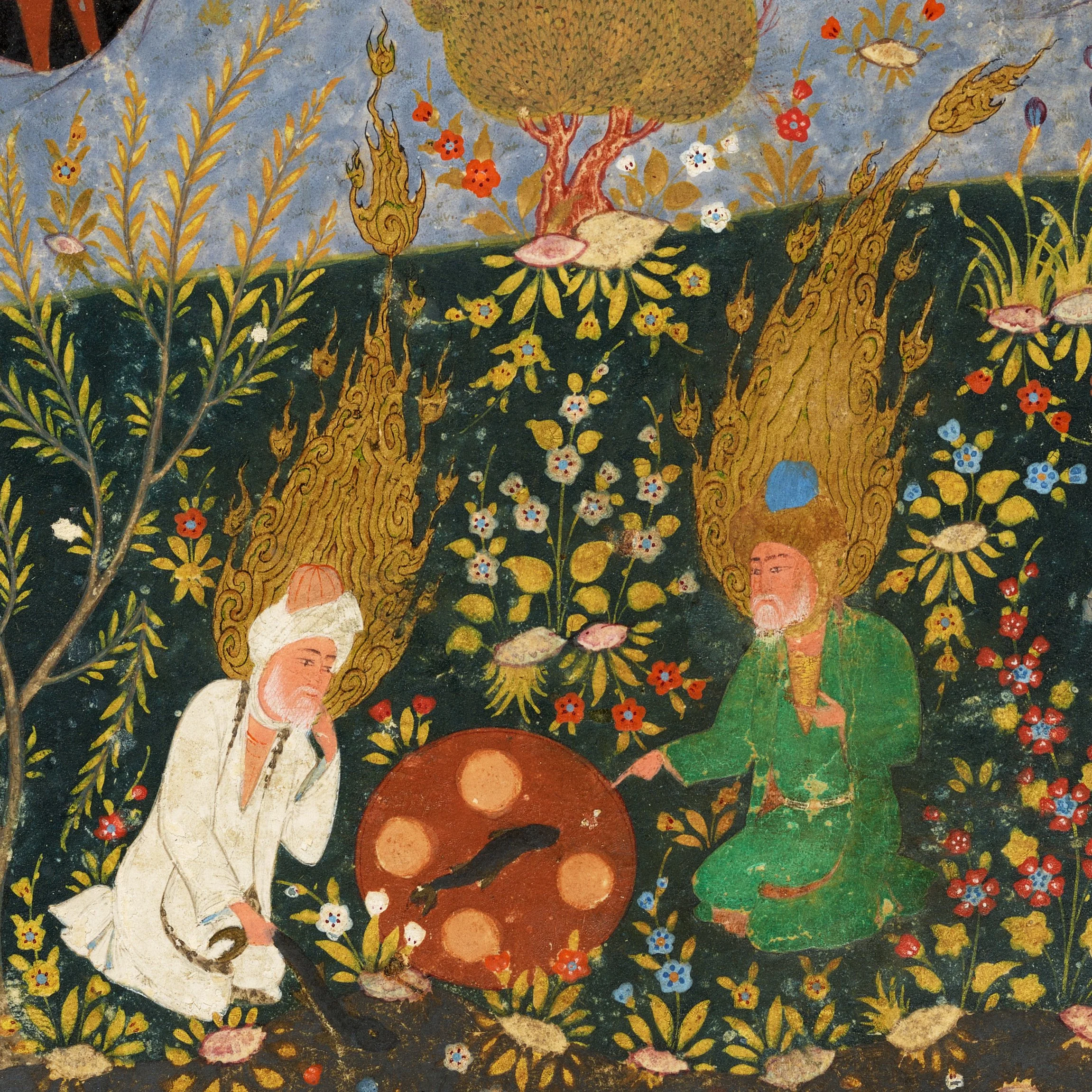
A Persian miniature depicting Al Khidr (right) with the Prophet Elijah. The manuscript dates to 1548 and depicts the pair sitting at the fountain of youth. In the Islamic tradition, Al Khidr serves as a guide leading the faithful to deeper spiritual truths.
Sheikh accompanies Link on his journey of ascension through the spiritual maqam’at, appearing at key moments to teach wisdom. Yet, she also disappears or vanishes at the critical moment, thus allowing the hero to meet his destiny on his own two feet. Sheikh exists as a liminal figure, balancing between male and female, visibility and invisibility, past and future. She never claims authority, identity, or loyalty, and helps the hero to remain faithful and true throughout the journey. Well-known analogues of Al-Khidr can be found in the Arthurian Merlin, Gandalf, Virgil (who guides Dante through his Inferno, disappearing once the protagonist encounters Beatrice, symbol of divine love), and Obi-Wan Kenobi. Biblical analogues include the Prophet Elijah, who often appears as a beggar, teacher, or stranger, guiding souls along their path, as well as the Jesus of the Gospels, who heals and harms in a way that invites introspection into divine mercy.
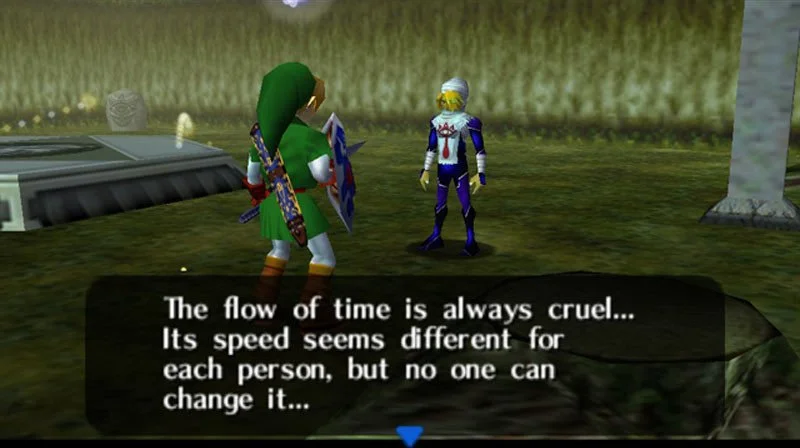
The Princess Zelda disguised as the enigmatic Sheikh appears to Link in the Forest Temple cleaning. Sheikh plays a Khidrian role, guiding the hero upon his journey through the spiritual stations (maqam’at).
Most poignantly, Sheikh teaches Link melodies on the ocarina, which serve as portals and gateways to higher stations. The ocarina itself is a powerful symbol representing a form of dhikr, or “remembrance” that reminds the spiritual seeker of the true unity of God (tawhid) behind forms as well as a recollection of one’s primordial innocence (fitrah). The Minuet of Forest, taught by Sheikh in the forest clearing, carries the soul back to this primordial longing for the peace and purity of childhood, where the clamor of the world fades into rustling leaves. The Bolero of Fire, with its urgent drums and flamenco-like flair, evoke passionate love (‘eshq) as well as the burning of the dross of the soul, a stage of purification that reflects the transmutation of base metals into gold. The Serenade of Water, with its lullaby-like melody, urges the soul to rest and to submit to the mercy of flow. The ethereal tone of the song greets Link as he emerges from the claustrophobic, murky labyrinth of tunnels below into the warm light and calm waters of Lake Hylia above, and represents sakinah (tranquil calm) as well as baraka (blessing), echoing the Quranic “with hardship comes ease” (Surat Ash-Sharh). The Nocturne of Shadow–a musical piece for the night–resonates with stillness and mystery. It draws the soul deep into the cave of its own illusion, evoking fearless trust and calm certitude amid hardship and confusion. Finally, the Requiem of Spirit–a hymn for the departed–represents a farewell to the old self and an opening into full integration. Its melancholic yet elevating melody carries the yearning of the soul for oneness and reunion with the Divine Source. As a Dhikr (form of remembrance), the melody reminds us of what is immortal in all of us, subtly implying the death of the ego (fana’) and restful abiding in God (baqa). It confronts the seeker with the promise that every farewell in this world is in truth a return to the Beloved.
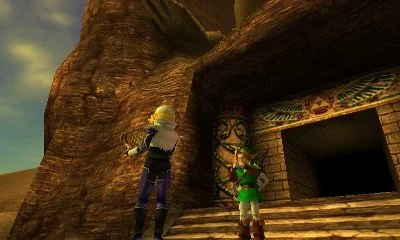
Sheikh teaches Link the Requiem of Spirit in the Gerudo desert
The final defeat of Ganondorf (al nafs al-mutakabirah) atop the soaring, dark and lofty peak of his castle is the final confrontation between Link’s spiritual maturity with arrogance and cruelty personified. The collapse of Ganon’s temple (the temple of the ego) represents the collapse of the “false city” of the lower self and the triumph of abiding within higher truth. Ganon is sealed away through the intercession of seven sages, each represented by the sacred medallion recovered from each respective temple. Rauru, guardian of the Temple of Light in the sacred realm, represents awakening, divine intellect (‘aql), and the original covenant with God. Saira, Link’s childhood friend from Kokiri forest, represents fitrah (primordial innocence) and taqwa (God-Consciousness). Darunia of the Gorons represents mujahadah (spiritual struggle) and the tempering of rage and base passions of the ego into higher spiritual states. The princess Ruto represents purity, emotional depth and surrender as well as sabr (patience) and ikhlas (sincerity). Impa, the forthright and courageous guardian of the Hyrule Royal Family, represents hidden knowledge, ancestral truth, and the importance of confronting fear (dark night of the soul).Nabooru–leader of the Gerudo desert tribes–represents the maqam (station) of tawba (repentence), as she is able to cast off her previous brainwashing and manipulation by Ganondorf to ally herself with the Good. Nabooru represents the soul’s ability to repent, evolve, and rise. Finally, the circle is sealed through the intercession of Zelda (Sheikh)--the seventh sage–who represents rahma (mercy) and divine gnosis(hidden knowledge).
At the end of the game, Link is allowed to live out the rest of his childhood–one that he had missed by breaking the seal of the Master Sword, catapulting him forward in time. He plays the Song of Time as a final act of dhikr. He returns wordlessly, with no fanfare, yet equipped with hidden knowledge and wise beyond his years. And, although Link has not changed physically, his journey through the various spiritual maqam’at has forever changed him, conferring maturity, courage, and compassion. By overcoming challenges and facing fears (the combined act of fana’ (self-annihilation) and baqa (subsistence in God), Link unveils a deeper unity (tawhid) beyond surface appearances and unlocks the gateway to the inner divinity, accessible to those who seek love and truth.