The Shell and the Kernel: Descent into the heart of Oneness and Truth
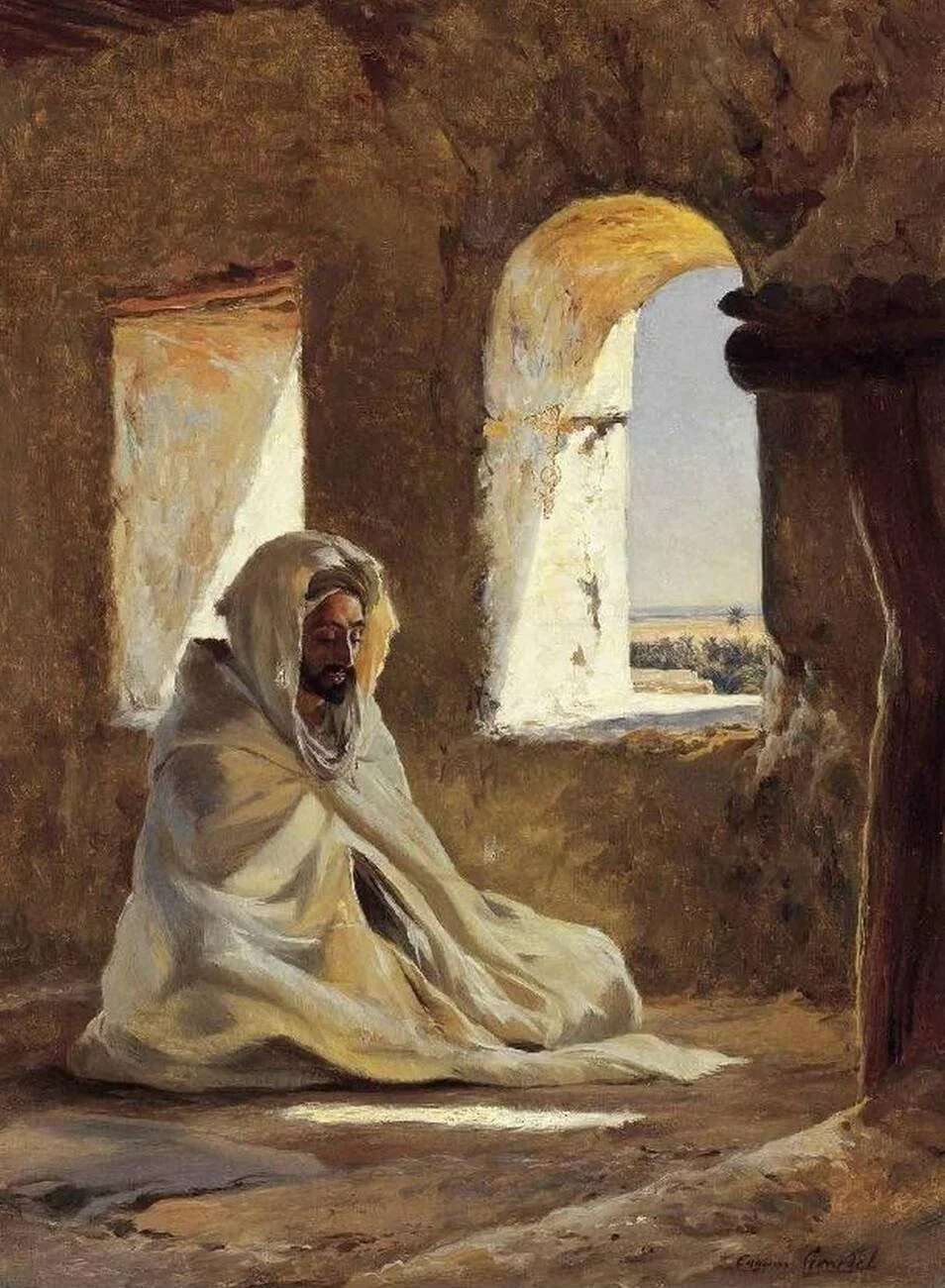
Algerian Sufi in prayer-Eugène Girardet (1907)
My heart has become capable of every form:
For gazelles a meadow, a cloister for monks,
For the idols, sacred ground, Kaaba for the circling pilgrim,
The tables of the Torah, the book of the Qur’an.
I profess the religion of Love:
Wherever its caravan turns, that is my belief and my faith. (Ibn Arabi)
Among one of his many prodigious treatises, the Andalusian scholar, philosopher and mystic Ibn Arabi (1165-1240) wrote Al-Qishr wa Al-Lubb (the Shell and the Kernel) as a reflection on the exoteric (outward, al-zahir) manifestations of religion in contrast to the esoteric (inner, al-batin) truth of unity and oneness (tawhid) at the core of all faith. In this respect, the outer casing or shell of the fruit represents the external, religious law (shari’a) addressed to, and made to be followed by all. Meanwhile, the inner kernel remains inaccessible but to a select few capable of discerning behind outer appearances and able to break beyond the veil concealing the deeper truth (al-haqq). This concept of gnosis, or ‘knowledge’ and ‘awareness’ of spiritual mysteries, is likewise reflected in the other great world faiths, Christ stating emphatically “before Abraham was, I am (John 8:58),” or “I and the Father are one” (John 10:30), while the Vedantic tradition dissolves the individual self (atman) into the universal reality (brahman). Arabi’s concept of wahdat al-wujud (the unity of being) reflects this very universal notion of the Godhead as am emanation, permeating and enveloping all things within a constant unfolding, an explosion of multiplicity out of unity and then dissolving back into the One.
In the words of the French esotericist René Guénon, there is no true ‘polytheism,’ whether among the Christians or the Hindus, as “one admitting an absolute and irreducible plurality of principles.” And, indeed, much of what accounts for aggressive religious division over external forms or scriptural dogma amounts largely to “the ignorance and incomprehension of the masses, from their tendency to attach themselves exclusively to the multiplicity of the manifested.” Behind the seemingly multifarious external forms of faith, ritual and dogma instilled by religious authorities one can find this singular notion of tawhid (Oneness) in all other faith traditions. One can compare the Biblical,” The Lord our God, the Lord is One” (Mark 12:29) with the Islamic “Qul Huwa Allahu Ahad” (Say, He (God) is One” (Surat Al-Ikhlas). Regardless, the latter text contains a paradox, one highlighted by Islamic scholar Martin Lings, who highlights the fact that among the 99 divine names of Allah are included Al-Haqq (The Truth) and Ash-Shahid (The Witness). If God alone is, and only His testimony is valid as Witness and the arbiter of Truth, then it is a hypocrisy and contradiction to set oneself up as witness when only God may exist as Witness. The witness must therefore be, according to Lings, not the self, but the Self (the greater, metaphysical Self as a reflection of God). Otherwise, one is repeating the Shahadah while creating a false dichotomy between creator and created. Indeed, while the traditional exoteric dogma (whether in Christianity or Islam) has been to create an unbridgeable gulf between God the creator and his creation–one with whom He becomes regularly impatient with and destructive towards as per the Old Testament–esoteric thinkers in both traditions have acknowledged the outpouring of God’s light and divinity in all of creation.
Thus, the famous utterance of the Baghdad Sufi martyr Mansour Al-Hallaj (858-922), “ana al-haqq” (“I am the truth”) encapsulates fully the end point of wahdat al-wujud (the unity of being) as the dualistic barrier between creator and created collapses and what is left is fana (annihilation) into the pure unity of God’s reality and Truth. This reflects what the Christian mystic Meister Eckhart stated, “all creatures are an utterance of God” as well as the words of St. John of the Cross that “God alone is, and all things are one in Him.” The Gospel likewise emphasizes this Christic notion of tawhid (Oneness), “that they all may be one, as You, Father, are in Me, and I in You” (John 17:21) while the Quran, in describing Christ as “ruh min Huwa,” ([likened to] a breath of God) acknowledges key aspects of the divine names (al-quddus/the pure and an-nur/the light) descending into man.
While Hallaj’s refusal to submit to religious dogmas at the time resulted in his torture and death, his statement regarding the presence of God’s divinity in all humans and, indeed, all of creation, reflects a deeper movement from the outer, exoteric understanding of the law (shari’a) to the inner Truth (al-haqq) that remains forever universal. Over the centuries, ulemas (bodies of Muslim scholars) of the various madhhab (schools of Islamic jurisprudence) have debated the extent to which certain dogmas must be concretized in order to maintain social order and clarity for the masses. Likewise, the early Church was ferocious in persecuting various gnostic and heterodox sects such as the Arians, Nestorians, and Monophysites. Apologists over the centuries have argued in favour of the need to maintain orthodoxy, with the Catholic apologist G.K. Chesterton stating:
“It was no flock of sheep the Christian shepherd was leading, but a herd of bulls and tigers, of terrible ideals and devouring doctrines, each one of them strong enough to turn to a false religion and lay waste the world. Remember the Church went in specifically for dangerous ideas; she was a lion tamer. The idea of birth through a Holy Spirit, of the death of a divine being, of the forgiveness of sins, or the fulfilment of prophecies, are ideas which, any one can see, need but a touch to turn them into something blasphemous or ferocious.”
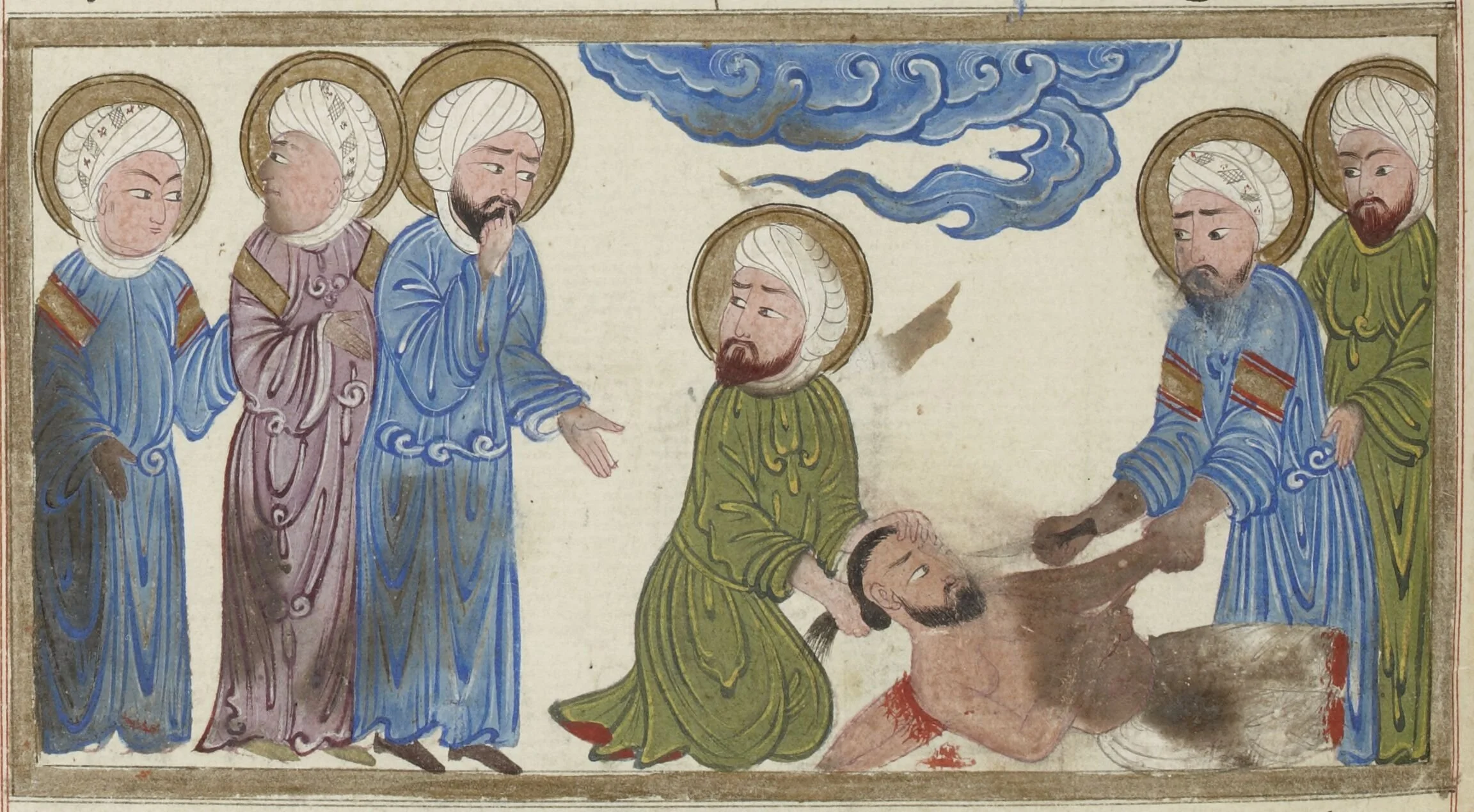
Execution of Al-Hallaj (Al-Āṯār al-bāqiya ʿan al-qurūn al-ẖāliya (Bibliothèque nationale manuscript, c. 16th century). Muḥammad ibn Aḥmad Abū al-Rayḥān al-Bīrūnī. Bibliothèque nationale de France. Département des Manuscrits. Arabe 1489. Folio: 113R.)
Without a doubt, such rigorous adherence to official dogmas–while providing scaffolding for the faithful–resulted in a concomitant desire among sages, mystics, and the spiritually-inclined towards the sacred realms of inner experience. Elif Shafak’s imaginative retelling of the relationship of the two Sufi mystics of Konya, Jalalaldin Rumi and Shems Al-Din, in The Forty Rules of Love, reminds us that:
“Each and every reader of the Holy Qur’an has a different understanding. There are four levels of insight. The first is the outer meaning, which most people are content with. Next is the bātın – the inner level. Third, there is the inner of the inner. And the fourth level is so deep it cannot be put into words and is therefore bound to remain indescribable.”
This inner level, to which Shems Al-Din was deeply connected and in which he sought to initiate Rumi, was precisely the “self-disclosure” of God (tajalli) inherent in every human being. Ibn Arabi likewise understood this concept as tanazzul (descent of divine being) and su’ud (ascent back to God). Ultimately, the insan al-kamil (perfect man), whether reflected in Christ or the Prophet Muhammed, is an invitation to understand ourselves as participating in the same divine journey of emanation and return. As the Neoplatonic maxim and the Quran (57:3) both say: “From Him is the beginning and to Him is the return.” This is mirrored in the well-known gnostic axiom as above, so below. A famous and oft-cited Hadith Qudsi states: “I was a hidden Treasure and loved to be known, so I created the world that I might be known.” Human beings are thus invited to become delegates of God and to ask themselves “to what extent are we able to truly live up to our divine potential:”
“The whole universe is contained within a single human being – you. Everything that you see around you, including the things you detest or even despise, is present within you in varying degrees. Therefore, do not look for Shaytan (the Devil) outside yourself either. The devil is not an extraordinary force attacking from without, but an ordinary voice within. If you set out to know yourself fully, facing your dark and bright sides with honesty and courage, you will arrive at a supreme form of consciousness.” (Rule 17-Forty Rules of Love)
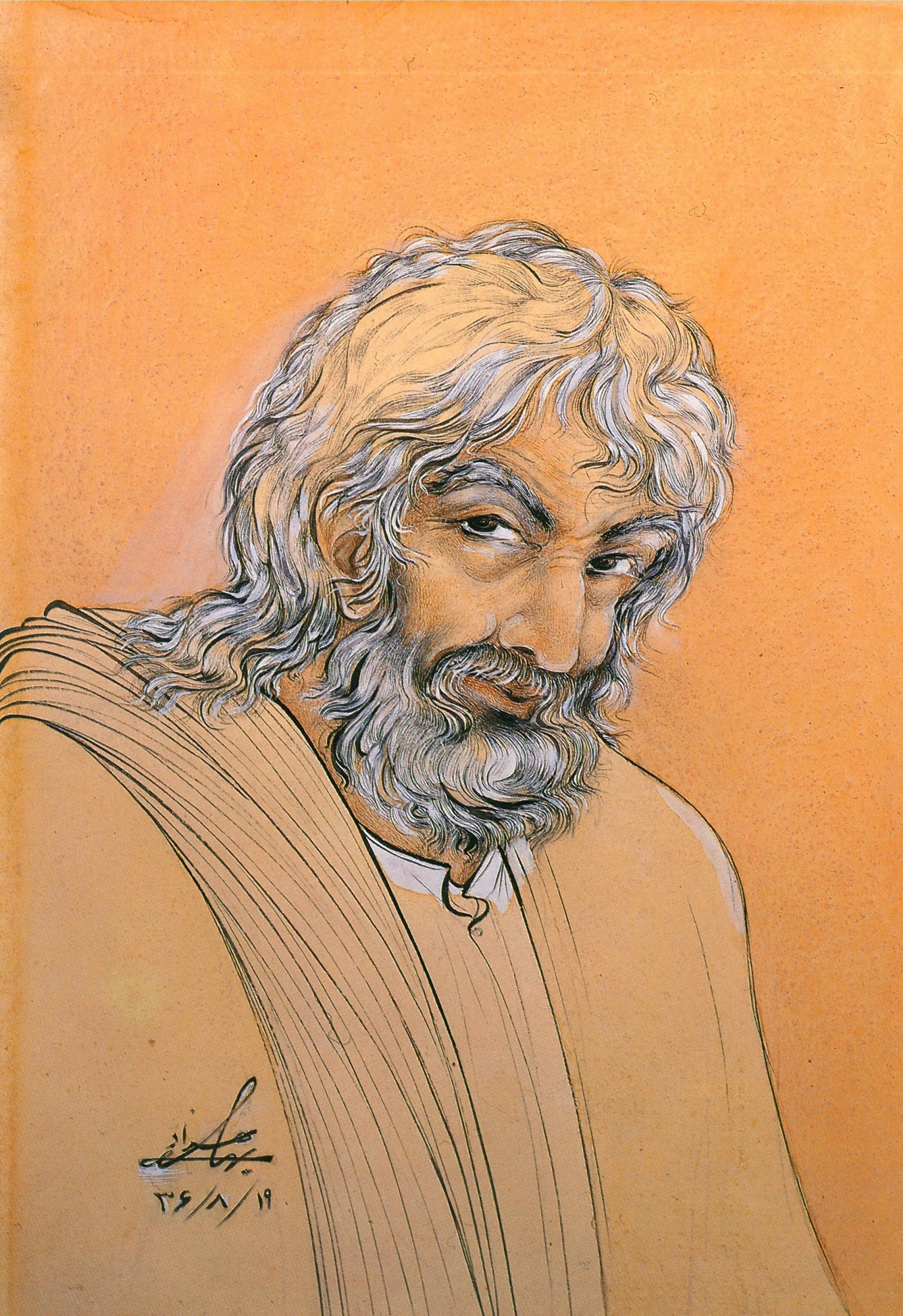
Miniature of Shems Al Tabrizi by Hossein Behzad (1957)
This higher form of consciousness–effectively moving beyond the zahir (outer) and into the batin (inner)--reflects what Frithjof Schuon has referred to as “the transcendental unity of religions.” Thus, while various religions may make statements that have the effect of denoting exclusivity–”No one comes to the Father but by me” and “none may meet Allah who has not first met the Prophet”--the Christ principle (representing the Logos, or divine, unifying Truth of God) exists within every faith tradition. The Hindu mystic Ramakrishna argued (along the lines of Guenon) that God has made different religions to suit different aspirants, times, and countries. All doctrines are only so many paths; but a path is by no means God himself. Whether one eats cake with icing straight or sideways, it will taste sweet either way.
You can study God through everything and everyone in the universe, because God is not confined in a mosque, synagogue or church. But if you are still in need of knowing where exactly His abode is, there is only one place to look for Him: in the heart of a true lover. (Rule 3-Forty Rules of Love)
Schoun has argued quite strikingly that while those traditions outside the Christian fold (namely Islam) are rejected out-of-hand by Christians due to the lack of Christ Jesus as saviour, they are “Christian” insofar that they accept a single, divine Truth (Logos/Al-Haqq) that inspires all of Revelation. In other words, a devout Hindu or Muslim may already be in possession of the “Christic Truth” in another form (the unity of God, or tawhid of Islam, for example), while not calling it “Christ,” and therefore not require conversion to the Christian faith. In this respect, Islam acts as a parallel “saving economy” for humanity and is therefore “whole and healthy” in Biblical terms.
Indeed, the mysterious words foretelling the arrival of the paraclete (the holy spirit as advocate or counselor) from the New Testament has been interpreted by some to foretell the final revelation of Islam through the Prophet Muhammed:
“And I will ask the Father, and he will give you another Advocate, to be with you forever. This is the Spirit of truth, whom the world cannot receive, because it neither sees him nor knows him. You know him, because he abides with you, and he will be in you.” -John 14: 16-17
Schuon has, in fact, referred to Islam as “the third act” in a symphony comprising the three monotheistic Abrahamic faiths (ahl al-kitab, “people of the book”). While the incarnation of Christ forms the “solar pole” (God as active, present and guiding in the world as a living savior), the descent of God’s word through the Quran forms the “lunar pole” (all light and creation is a reflection of the Oneness of God). And, just as Christianity has been interpreted as an esotericism of Judaism (an incarnation of God’s love to soften the Law brought down by Moses), Islam can be interpreted as an esotericism of Christianity (a movement beyond incarnation towards absolute unity and oneness).
Christian mystical thinkers throughout the centuries have instinctively understood the paradox of multiplicity springing from oneness while simultaneously accepting the reconciliation of all things within a single unity. The Greek Church Fathers, especially, described the Godhead in terms remarkably similar to Sufi notions of Al-Dhat (one divine Essence), Al-Kalimah (God’s eternal word, or self-expression), and Al-Ruh (God’s life-giving spirit). Gregory of Nyssa, the 4th century theologian, argued that what we name Father, Son, and Holy Spirit was made up of one ousia (essence) fully shared by all three, with any distinction between them merely relational, not in separate substances or wills. In the 8th century, St. John of Damascus summarized the doctrine thusly: “for verily there is one God, and His word and spirit [share] the same essence and dwell in one another.” In this respect, this “tawhid-informed” concept of the Trinity does not partition the three Persons of the Godhead, but rather sees Them as three candles kindled from the same flame.
Late medieval and Renaissance thinkers of the Christian world likewise embraced certain Islamic philosophical concepts emanating from Cordoba, within Moorish Andalusia. The Catalan mystic Ramon Llull (1232-1316) learned Arabic and incorporated Sufi concepts and virtues he had learned from Islamic thinkers in Mallorca and North Africa. In particular, Llull developed a system of contemplating the various attributes of God based off of the asma al-husna, the “99 names of Allah”, that are recited by Muslims. By meditating upon these attributes–al hakim (“the wise”), al-jalil (“the magnificent”), the aforementioned al-haqq (“the truth)”) and al-quddus (“the pure”), al khaliq (“the creator”) to provide some examples–and by then transforming them into what he called the dignities or virtues (“power,” “will,” “eternity”, and so forth), Llull sought to bridge linguistic and theologian barriers by translating Sufi metaphysics into a Christian tone.
The Renaissance cardinal and polymath Nicolas of Cusa (1401-1464), developed a concept of the "coincidence of opposites”, in which all binary oppositions (motion vs. rest, maximum vs. minimum, unity vs. trinity etc) are transcended. In De Docta Ignorantia (“On Learned Ignorance”), Cusa contended that knowing God requires acknowledging the failure of ordinary reasoning, believing that only a higher, intuitive insight can grasp the One in the Many, and the Many in the One. Cusa viewed God as the “Not-Other,” the bountiful and primordial source of All, in which all multiplicity is enfolded. This idea is deeply harmonious with Ibn Arabi’s cosmology, by whom Cusa was influenced and in fact cited in his works. Much like the Sufis, Cusa would describe God as an infinite circle, within which the circle’s center and circumference are one, and the maximum is the minimum. These paradoxical analogies served as ways to demonstrate how dualistic “eitjher/or” thinking breaks down when faced with the infinite.
“It is the first rule, brother… How we see God is a direct reflection of how we see ourselves. If God brings to mind mostly fear and blame, it means there is too much fear and blame welled inside us. If we see God as full of love and compassion, so are we.” (Rule 1–The Forty Rules of Love)
Shams Al-Tabrizi delivered these words to a skeptical innkeeper, explaining that one’s view of God mirrors one’s own inner state. While a fearful, judgmental image of the Divine may indicate a heart filled with fear, those whose Godview is compassionate or merciful (al-rahim) mirror God’s love and divinity within themselves. Arguments and theological battles over semantics miss the bigger picture: the fundamental unity of divine love and wholeness within the multiplicity of the manifested, as interpreted by finite and fallible human beings.
Most of the problems of the world stem from linguistic mistakes and simple misunderstandings. Don’t ever take words at face value. When you step into the zone of love, language as we know it becomes obsolete. That which cannot be put into words can only be grasped through silence. (Rule 5–Forty Rules of Love)
Works Cited:
Guénon, René. Insights into Islamic Esoterism and Taoism.
Translated by Gustavo Polidori, Sophia Perennis, 2004.
Lings, Martin. What Is Sufism?
University of California Press, 1975.
Schuon, Frithjof. The Transcendent Unity of Religions.
Translated by Peter N. Townsend, Quest Books / Theosophical Publishing House, 1993.
Shafak, Elif. The Forty Rules of Love.
Penguin Books, 2010.