Classical Education: Trivium and Quadrivium
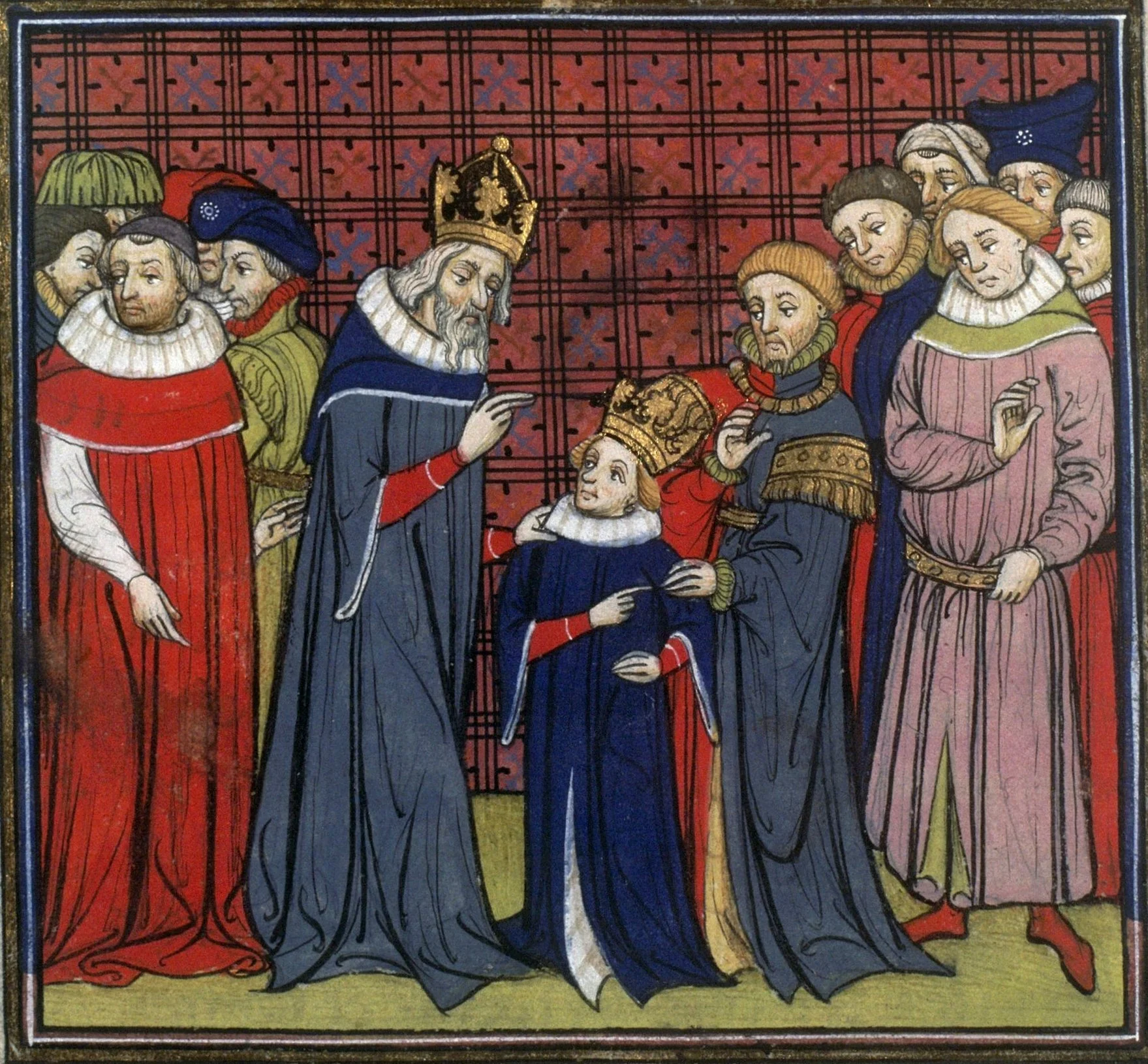
Charlemagne instructs his son Louis the Pious (Grandes Chroniques de France, Paris (BnF Français 73, fol. 128v).
“To be ignorant of what occurred before you were born is to remain always a child.”
— Cicero, Orator, 120
The revival of classical education in North America has led to a myriad of private and charter schools and has profoundly transformed the educational landscape. No longer marginal or merely boutique, classical education has grown by leaps and bounds, expanding the choices available to parents seeking to strengthen their child’s literacy, critical thinking, and civilizational awareness. Drawing upon the great books, Greek philosophy, and Latin rhetoric, classical education seeks to awaken wonder, discipline thought, and instill a lifelong love of the true, the good, and the beautiful.
In the influential essay The Lost Tools of Learning (1948), Dorothy Sayers outlined the key facets of classical education: the Trivium (grammar, logic, rhetoric) and Quadrivium (arithmetic, geometry, music, astronomy). Aiming to teach the tools of learning prior to the subjects themselves—which have multiplied given the increased complexity of the modern world—Sayers emphasized the importance of acquiring intellectual arts as opposed to merely accumulating subject knowledge. Much like an understanding of music theory, scales, and notation allow one a far deeper ability to play the piano rather than memorizing a single piece, students need to understand how conclusions are reached, how to approach unfamiliar problems, investigate independently, connect knowledge, and continue the learning process deep into life. This foundation of critical thinking, Sayers argued, would serve students far better than merely reproducing knowledge, passing examinations, or understanding subjects as isolated and compartmentalized elements as opposed to forming a holistic unity across domains.
THE TRIVIUM
The grammar stage—roughly corresponding to the Elementary ages of grades K-6—is buttressed by a rich bounty of accumulated knowledge acquired when memory, observation, and learning by heart come naturally. Ideal subjects include Latin grammar, poetry and prose, myths and legends, historical dates and personalities, maps, rivers, mountains and capitals, as well as multiplication tables, geometric forms, and religious scripture and doctrine. The grammar stage forms the basis of all subsequent learning and provides a firm foundation of knowledge upon which the child can later build and form arguments, invent, create, and develop confidence through possessing a rich body of facts, dates, and places. The learning of classical languages, namely Latin, plays a particularly important role for Sayers, for whom the chanting of “amo, amas, amat” should be as “ritually agreeable to the feelings” as the chanting of “eeny, meeny, miney, mo (p.12) .” An early introduction to the architecture and structure of Latin and other inflected languages prepares children for further learning at an age when the mind is malleable and adaptive.
“It is a great mistake to suppose that a child cannot readily enjoy and remember things that are beyond its power to analyse.” (p. 13)
The logic stage—corresponding with Middle School (grades 7-9)—takes advantage of the natural precociousness of adolescents by channeling their natural argumentativeness with formal logic, debate and disputation, the definition of terms and analysis of arguments, as well as the evaluation and comparison of sources. At this age, students enjoy engaging in increasingly vigorous debates on controversial subjects, which awakens a desire to form cohesive arguments and defend particular points and conclusions. One especially important aspect of the logic stage is the focus on detecting weak arguments, sophistic fallacies, and emotionally manipulative language designed to engineer a distorted image of reality.
“We let our young men and women go out unarmed, in a day when armour was never so necessary.” (p. 9)
The rhetoric stage—which marks the final grades of High School (10-12)—brings students accumulated knowledge into a new, creative synthesis. Students quickly really that while there is a desire to argue and browbeat opponents in debate, that the volume of knowledge they have ready access to and their ability to bring together disparate subjects is lacking. At this stage, students should be strongly encouraged to carry out their own research and develop an appreciation for the myriad webs of connections interlinking seemingly separate topics. Sayers places theology as the “mistress science (p.14),” which is uniquely capable of unifying the mathematical precision and intricacies of geometry, arithmetic, music, and astronomy—the Quadrivium, or mathematical half of the seven liberal arts — with the poetic beauty and creativity of grammar, logic, and rhetoric.
“Rhetoric will tend to show that all knowledge is one.” (p. 17)
THE QUADRIVIUM
In the Platonic tradition, arithmetic was valued for helping conceptualize abstraction, pattern recognition, ratio and proportion, as well as distinguishing example from the deeper principle, thereby encouraging the mind to move beyond outward appearances (mere counting) towards intelligible structure. Geometry, a science of key importance since ancient times, brings arithmetic number into spatial relationship through an understanding of area and volume, symmetry, proportion, and congruence. Geometry develops the spatial imagination and allows the mind to move from visible diagrams to the abstract, and vice verca. While a crudely drawn triangle may lack perfect geometric proportion, the deeper truth to which it alludes represents an eternal truth. Plato, in his Republic (book VII) exclaimed that geometry is the science that can “draw the soul towards truth,” by distinguishing between material representation and a deeper intelligible reality.
Music, in the classical tradition, is not simply understood as either appreciation or performance of favorite music pieces, but rather as the crystallization of number in ratio and harmony. The study of octaves (2:1), perfect fifths (3:2) and the like teach a recognition of recurring patterns, sensitivity to ratio and proportion, as well as memory and temporal awareness. At an even deeper level, the harmonics inherent in music teach an understanding of harmony and dissonance as well as the truth of a deeper unity within multiplicity and an appreciation for the beauty inherent in mathematical truth. The emphasis on harmony mirrors Platonic and Aristotelian themes of mastering one’s appetites and finding balance between one’s conflicting impulses while music also introduces a key moral analogy, namely that freedom does not require the absence of order.
Finally, astronomy represents a synthesis between the calculation of periods and cycles within spatial relationships in a unified harmonious proportion. In this respect, astronomy incorporates the other elements of the Quadrivium (arithmetic, geometry, music) into a profound understanding of how the movement of the celestial spheres, the planets and stars, places humanity in proportion with eternal mathematical and divine truths. Historically ancient peoples, whose seasonal festivals, calendars, agriculture and navigation depended on an accurate understanding of astronomy, have intuitively understood the significance of studying the heavens. While mathematical modelling and an awareness of scale, cycles, and periodicity are clearly fruits students may pluck from the tree of the astronomical sciences, it is rather a sense of awe before the magnitude of the cosmos that reveals the deeper benefit of studying astronomy. Prolonged and careful observation teaches patience and humility before the majesty of God while time slowly reveals and ripens the fruit of knowledge, a synthesis of number, space, and harmony in perfect proportion.
CONCLUSION: ON THE VALUE OF THE LIBERAL ARTS AND CLASSICAL EDUCATION
The liberal arts—the Trivium and Quadrivium—have formed the basis of centuries of learning. Through disciplined instruction of Latin and Greek grammar, the ancient classics, stories, and myths of our ancestors, classical education opens a gateway of initiation into a precious cultural inheritance. While modern education has slowly and steadily eroded many of the pillars buttressing classical education— through a focus on so-called practical skills, vocational training, and increasingly greater awareness of contemporary political issues—an education firmly rooted in the Trivium and Quadrivium offers a concrete basis in the structure of language and number that make deeper harmonies of truth, order, and beauty intelligible. Students firmly grounded in classical education develop a deep appreciation for the true, the good and the beautiful, through a holistic study of God’s creation and mankind’s place in the cosmos.
SOURCES:
Sayers, Dorothy L. The Lost Tools of Learning: Paper Read at a Vacation Course in Education, Oxford, 1947. Methuen, 1948.